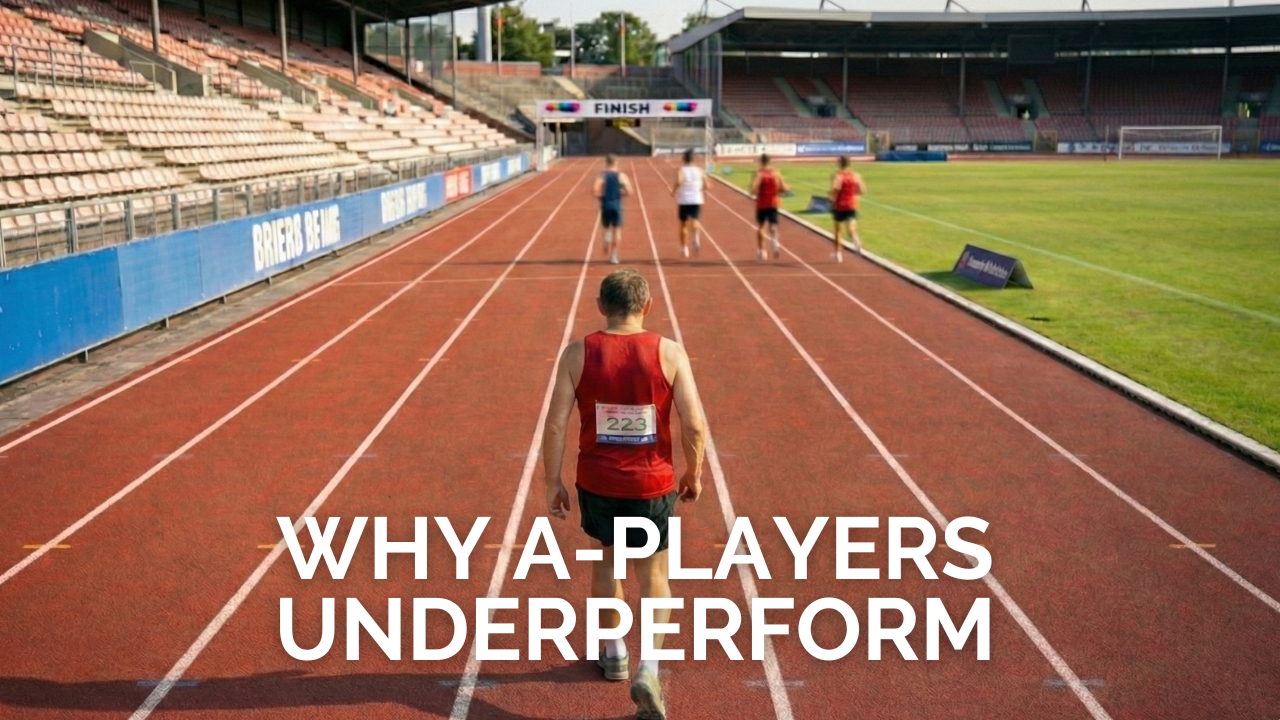
Why A-Players Underperform
There is a moment that happens quietly for a lot of high performers.
From the outside, everything still looks good. The title fits. The résumé holds weight. The capability is unquestioned. People still assume you are fine.
But internally, something has shifted.
The work that once felt energizing now feels heavy. The pace that used to excite you now exhausts you. You still deliver, but it takes more effort than it should. And the gap between what you know you are capable of and what you are actually producing starts to feel uncomfortable.
Not dramatic. Not explosive.
Just a steady sense of underperformance that does not match your identity.
This is where many A-players quietly live for far too long.
The Story Beneath the Surface
Most A-players carry an unspoken narrative.
“I should be able to figure this out.”
“If I just push harder, this will pass.”
“Others would be grateful for this role.”
So instead of naming the friction, they normalize it. They tell themselves the problem must be a lack of discipline, focus, or motivation. They assume the issue is personal rather than structural.
That story keeps them stuck.
Because A-players are used to solving problems through effort, they rarely question whether the environment itself is working against them. They internalize the struggle instead of examining the conditions creating it.
Over time, this erodes confidence. Not loudly, but subtly. Performance drops. Engagement fades. The very traits that made them exceptional start to dull.
How This Pattern Gets Reinforced
It usually unfolds in a predictable way.
A thought appears: “I should be doing better.”
That thought turns into a belief: “Something must be wrong with me.”
That belief shapes behavior: overworking, self-editing, disengaging emotionally.
Those behaviors produce outcomes: reduced creativity, slower decisions, muted results.
The system reinforces itself.
Because the output is lower, more pressure is applied. Because more pressure is applied, the A-player tightens further. And instead of unlocking performance, the environment quietly suppresses it.
Nothing is technically broken. But nothing is fully aligned either.
A Real Moment That Changed Perspective
I have seen this most clearly in leaders who were once top individual contributors.
They were promoted because they excelled. They produced disproportionate value. They moved quickly. They saw patterns others missed.
Then they were placed into roles that required constant consensus, heavy oversight, or managing energy instead of applying it.
Their performance dipped.
And the diagnosis was almost always wrong.
They were labeled resistant, disengaged, or no longer hungry. In reality, their strengths were being constrained. Their initiative was slowed by borrowed authority. Their intelligence was underutilized. Their integrity was intact, but misaligned with the demands of the role.
Nothing was wrong with the person. Everything was misfiring around them.
Why This Is Hard to Change Alone
A-players are often surrounded by systems that reward endurance over alignment.
Organizations reward availability. Teams reward compliance. Leadership structures reward control more than trust.
Within those systems, awareness is not enough. Even when an A-player recognizes the mismatch, they often lack permission to change it. Speaking up can feel risky. Stepping back can feel like failure. Asking for structural support can feel unnecessary or indulgent.
So they adapt instead.
And adaptation, over time, becomes underperformance.
What This Really Requires
A-players do not need more motivation.
They need alignment.
Alignment between role and strengths. Alignment between authority and responsibility. Alignment between environment and how they actually operate best.
This requires honesty about what drains versus energizes. It requires small, repeatable adjustments rather than dramatic exits. And it requires support that understands how high performers truly function.
Not tighter management. Clearer positioning.
Not more pressure. Better context.
When those conditions are met, A-players do not need to be pushed. They re-engage naturally.
Where This Leaves You
Underperformance is not always a personal failure.
Sometimes it is a signal.
A signal that the environment no longer matches the level of contribution you are capable of making. A signal that your strengths are being muted rather than multiplied.
When you stop trying to fix yourself and start examining what surrounds you, clarity returns. Performance follows.
Not through force. Through fit.
Want to Go Deeper?
This topic is explored further in the Empowered Team Podcast episode Why A-Players Underperform. The conversation breaks down what actually defines an A-player and what unlocks their best work when results start to slip.
If this reflection resonates, coaching support can help you realign role, authority, and environment so your performance matches your capacity again.
Listen to the episode here:
https://podcasts.apple.com/us/podcast/why-a-players-underperform/id1439022418?i=1000748850923
Explore coaching support here:
https://link.theempowered.ca/widget/bookings/empowered-performance-meet-kari
Strong performance is not about doing more. It is about being positioned to do what you already do best.


