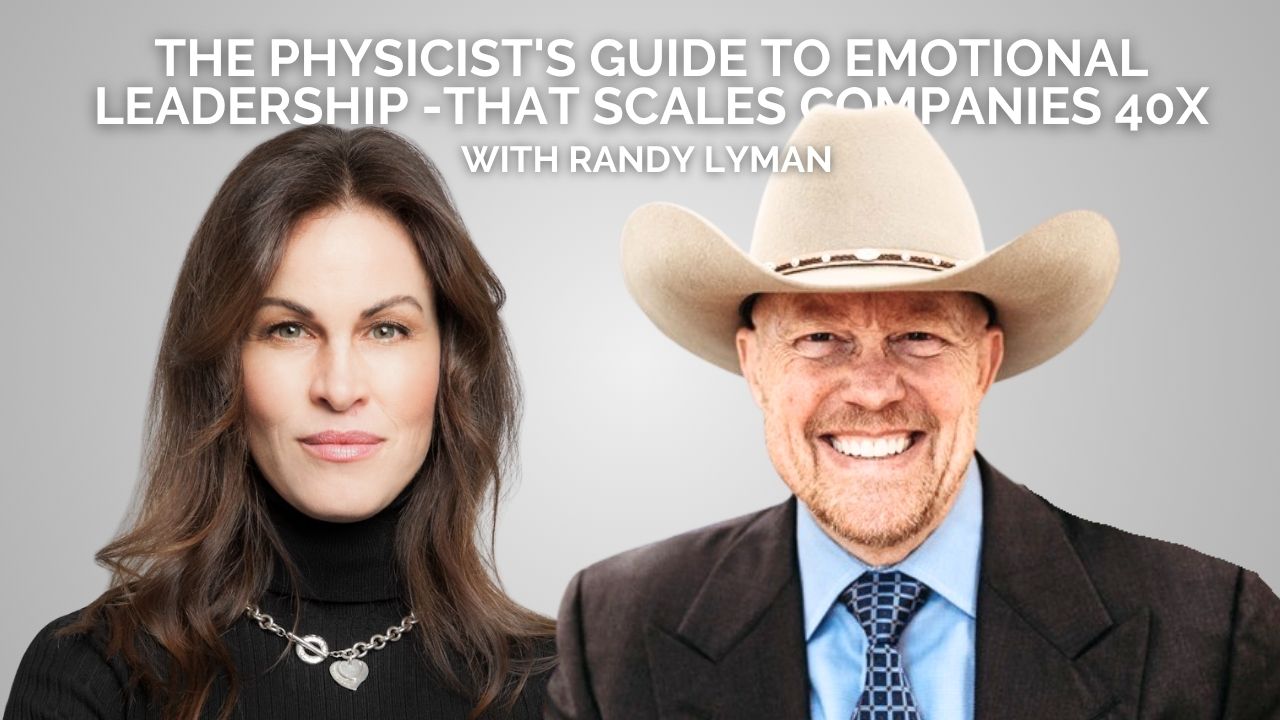
Randy Lyman Interview: The Physicist's Guide to Emotional Leadership -That Scales Companies 40x
What happens when logic, intuition, and emotional healing finally work together
There is something unexpected about Randy Lyman.
On paper, he is a physicist, entrepreneur, patent holder, and builder of multiple eight-figure businesses, including an Inc. 500 company.
He understands systems. He understands logic. He understands scale.
And yet the lesson that transformed his leadership was not purely strategic.
It was emotional.
For years, Randy operated from the mindset many high performers know well. Work hard. Think clearly. Push through. Stay left-brained. Turn emotions off because they only get in the way.
That approach produced results.
But it did not produce the kind of fulfillment, clarity, and leadership capacity that he would later discover was possible.
What changed everything was not abandoning discipline or ambition.
It was learning how to integrate the emotional side of being human into the way he lived and led.
The Story Beneath the Surface
Before emotional awareness became central to his philosophy, Randy was leading from force.
Like many leaders shaped by performance-based environments, he learned early that success came from intelligence, discipline, and pressure. Emotions were seen as distractions. Sensitivity was not useful. Strength meant pushing through.
That mindset worked, until it didn’t.
He already had successful businesses. He already knew how to solve problems and generate results. But beneath the momentum was another reality. He was leading without fully understanding his own emotional landscape, and that affected the way he showed up with other people.
As he began exploring the emotional and spiritual dimensions of life, he realized something deeper. Human beings are not driven by logic alone. Teams are not made effective by force alone. And leadership does not become sustainable by simply working harder.
It becomes sustainable when leaders learn to integrate thought, action, and emotion.
That integration became the third element behind the growth Randy would later experience.
How This Pattern Gets Reinforced
In many business environments, emotional disconnection gets rewarded before it gets exposed.
Leaders who stay tough are often seen as strong. Leaders who push harder are praised for their drive. Teams that keep producing under pressure are labeled resilient, even if they are operating from fear, tension, or emotional fatigue.
Over time, this creates a familiar loop.
Pressure rises.
The leader tightens control.
Emotions are ignored or suppressed.
Communication becomes more guarded.
The team responds to the leader’s tension, often without anyone naming it directly.
People become cautious. Creativity narrows. Trust weakens.
Then productivity becomes harder to sustain, which convinces everyone to push even harder.
Randy came to see that this cycle is not just operational. It is emotional.
A tense leader creates tense environments. A guarded leader creates guarded teams. A leader who has not worked through personal emotional baggage often ends up leading from it, even with the best intentions.
This is where many leadership challenges begin.
Not in strategy, but in the unexamined emotional patterns behind the strategy.
A Real Moment That Changed Perspective
One of Randy’s most important turning points came after a deep emotional breakthrough during a four-day leadership communication retreat.
He had been working hard to solve recurring issues in his life and business, especially around people he perceived as incompetent or difficult. He was trying to fix the problem externally, through thought and effort.
Then something shifted.
During the retreat, Randy confronted a deep emotional wound connected to competence and how he had internalized being seen by others, especially family. The release was profound.
When he returned to work just a few days later, the outside problems he had been battling began to change.
People who had seemed persistently incompetent either became capable almost immediately or left his life altogether.
That moment changed how he understood leadership and challenge.
As a scientist, he saw it as cause and effect. The emotional release came first. The external shift followed.
From that point on, he stopped viewing every irritation as merely a business problem to solve. He began asking what emotional pattern, pain, or unresolved wound might be interacting with the situation.
That shift became foundational.
Not just in his healing, but in how he built companies that eventually scaled far beyond what he had created before.
Why This Is Hard to Change Alone
The hardest part about emotional leadership is that most people were never taught it.
Many leaders were conditioned from an early age to suppress emotion in order to survive, perform, or belong. Men were often taught that compassion, tenderness, and vulnerability made them weak. Women were often taught that to lead effectively they had to over-identify with masculine traits and distance themselves from their natural relational strengths.
By adulthood, these patterns are deeply embedded.
Then leadership adds another layer.
The more responsibility people carry, the more pressure they feel to appear certain, composed, and in control. Vulnerability can feel risky. Emotional honesty can feel impractical. Slowing down to examine internal patterns can feel like a luxury they cannot afford.
But Randy’s experience showed the opposite.
When leaders avoid their emotional wounds, those wounds do not disappear. They leak into meetings, negotiations, relationships, and decision-making. They distort perception. They amplify defensiveness. They make teams less safe and less effective.
This is why awareness alone is not enough.
Insight must be followed by practice, humility, and the willingness to keep healing layer by layer.
What This Really Requires
Randy’s leadership philosophy became clearer over time.
People do their best work when they feel acknowledged.
They become more engaged when they know they are contributing.
They become more effective when they feel they belong.
That kind of culture cannot be manufactured through slogans. It has to be created through the leader’s way of being.
For Randy, that meant learning how to listen at a deeper level. Not listening to respond. Not listening to control the outcome. Truly listening until the other person felt heard enough to become open.
It also meant becoming more self-aware before entering conversations. If stress was present, he learned to recognize it rather than letting it unconsciously set the tone for the room.
It meant becoming vulnerable enough to admit uncertainty and confident enough to ask for help.
That combination changed everything.
Instead of seeing leadership as projecting power, he began seeing it as creating emotional safety, clear standards, and genuine connection at the same time.
This was not softness.
It was leverage.
It allowed teams to engage more fully, collaborate more honestly, and perform more consistently. It transformed the quality of communication. It strengthened culture. And it helped scale businesses 30 to 40 times beyond what had been possible before.
Where This Leaves You
Randy Lyman does not separate business success from emotional growth.
He integrates them.
He is still logical. Still disciplined. Still strategic. Still deeply grounded in science and systems.
But he sees emotional healing as one of the most practical leadership tools available.
He believes leaders must do more than think clearly and work hard. They must understand the emotional forces shaping how they show up, how their teams respond, and how their organizations grow.
Real leadership is not about pretending emotion does not exist.
It is about becoming grounded enough to work with it wisely.
That shift changes more than culture.
It changes how success feels.
It changes how teams function.
And it changes the kind of leader a person becomes when performance is no longer built on pressure alone.
Want to Go Deeper?
This blog is inspired by The Empowered Team Podcast conversation with Randy Lyman. In the full episode, he explores emotional healing, intuition, leadership, business growth, and why lasting fulfillment requires more than logic alone.
Listen to the full episode here:
https://podcasts.apple.com/us/podcast/randy-lyman-interview-the-physicists-guide-to/id1439022418?i=1000761052499
If you are building a company and want stronger leadership, deeper alignment, and a more human-centered culture, you can book a leadership conversation here:
https://link.theempowered.ca/widget/bookings/empowered-leadership-consulting-meet-kari


