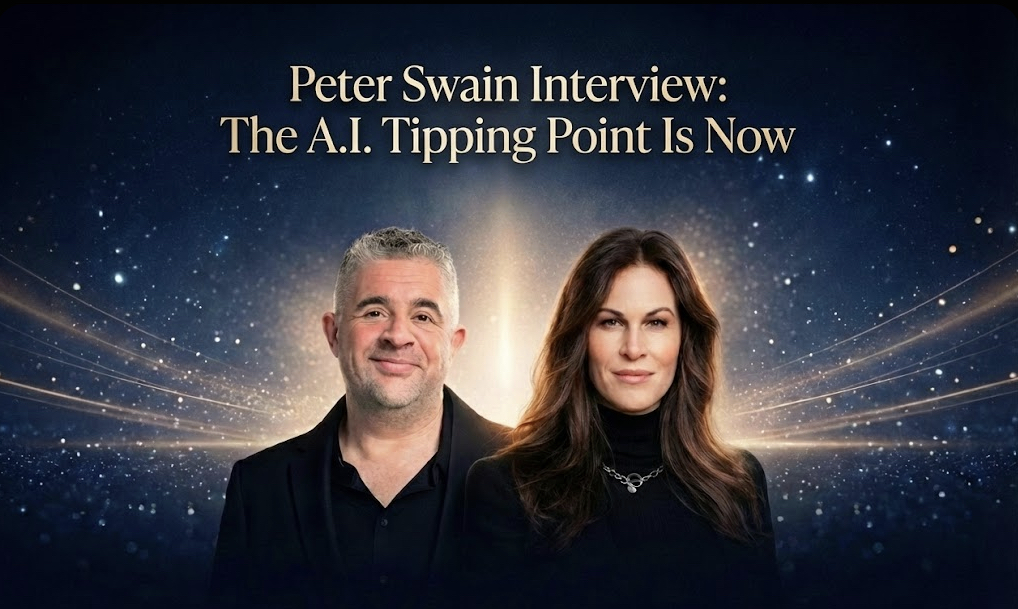
Peter Swain Interview: The A.I. Tipping Point Is Now
There are moments in history when the future stops being theoretical.
This is one of them.
Artificial intelligence is no longer emerging.
It is here.
And it is already reshaping work, leadership, and how value is created.
In this conversation with Peter Swain, we move beyond speculation and into consequence.
Not predictions.
Patterns.
Because when disruption becomes structural, opting out is no longer neutral.
Artificial Intelligence Is Not New. Access Is.
Artificial intelligence has existed for decades. What changed is accessibility.
For the first time, intelligence itself has been democratized.
This is not simply a technological milestone.
It is a structural one.
When tools for analysis, creation, and decision-making become widely available, the hierarchy of value reorganizes. Skills that once created advantage become baseline. Execution accelerates. Expectations rise.
This is why the current moment feels disorienting for so many leaders and professionals.
Not because AI is replacing everything overnight.
But because it is quietly redefining what competence looks like.
And that shift does not wait for comfort.
The Three AI Timelines Leaders Need to Understand
Peter outlines three overlapping timelines shaping the future of artificial intelligence and the future of work.
These timelines are not predictions.
They are directional signals.
The 30-Year Horizon: Capability at Scale
This is the timeline most people want to talk about.
A world where AI helps solve problems humans cannot solve fast enough. Disease. Energy. Climate. Complexity.
The promise is extraordinary.
But it raises a question that often goes unspoken.
If every problem becomes solvable, what gives human life meaning?
Growth has always been driven by necessity. When necessity disappears, identity must reorganize.
This is not a technical challenge.
It is a human one.
The 10-Year Horizon: Artificial General Intelligence
This is where artificial general intelligence enters the conversation.
Intelligence that can adapt across domains rather than operate in narrow tasks.
Not just answering questions.
But directing outcomes.
This challenges one of humanity’s longest-held assumptions.
That humans will always be the most capable decision-makers in the room.
The discomfort here is not about machines.
It is about hierarchy.
The 3-Year Horizon: Economic Reality
This is the most immediate and disruptive timeline.
As organizations become more efficient without employing more people, production increases while consumer purchasing power declines.
This creates what Peter describes as a producer–consumer paradox.
The system strains.
This is already visible in job displacement data, hiring trends, and organizational restructuring across industries.
The pace is accelerating.
What Our Economic Systems Were Never Built to Handle
One of the most sobering insights in this conversation is not about AI itself, but about the systems built around human labor.
Modern economic models depend on a simple loop.
People earn money. People spend money. Demand fuels production.
AI disrupts this loop at the supply level.
When productivity increases without corresponding employment, efficiency rises but circulation slows. Businesses become more capable while consumers become less able to participate.
This is not theoretical.
We are already seeing early signals in white-collar hiring slowdowns, automation-driven layoffs, and widening gaps between productivity and wages.
The challenge ahead is not simply technological adoption.
It is economic adaptation.
And that adaptation has not yet caught up.
Why Opting Out of AI Is Still a Choice
Refusing to engage with AI does not slow it down.
It only removes your influence.
This is not about enthusiasm or resistance.
It is about participation.
Every major technological shift has reshaped industries regardless of personal opinion. The internet did not wait for consensus. Mobile did not wait for comfort.
AI will not either.
The real question is not whether AI will change your world.
It is whether you will help shape how it shows up in yours.
Flexibility as a Leadership Advantage
Peter shares a story from earlier in his career that reframes what resilience actually looks like.
After running a business through major global disruption, he made a defining choice in how he builds companies.
Flexibility over optimization.
Shorter commitments. Portable systems. Decentralized infrastructure.
Not because it was cheaper.
But because it allowed movement.
In an AI-driven world, rigidity becomes risk.
The leaders and organizations that endure will not be the most optimized.
They will be the most adaptable.
The Unexpected Advantage of Human Skills
As automation increases, human presence becomes rarer.
And rare things become valuable.
Peter highlights a shift that is already underway.
Skills like communication, empathy, discernment, and judgment increase in value as technical execution becomes automated.
These are not “soft skills.”
They are leadership skills.
And they may become the most differentiating advantage in an AI-first world.
Raising Humans in an AI-First World
One of the most personal moments in the conversation comes when Peter speaks about his children.
In a world where information is unlimited, traditional markers of intelligence lose relevance.
Credentials matter less.
Memorization matters less.
Execution matters less.
What remains is character.
The ability to relate.
To communicate.
To navigate uncertainty without collapsing into fear or control.
This is not about preparing children for specific jobs.
It is about preparing humans for a world that requires emotional intelligence, adaptability, and self-trust.
A Practical Way to Start Using AI
For those unsure where to begin, Peter offers grounded guidance:
Start small and consistent. Even fifteen minutes a day builds fluency.
Direct AI when you are the expert. Let it guide you when you are not.
Prioritize context over clever prompts. Clarity produces better intelligence.
If a task that once took days now takes minutes, slow down. You may have skipped essential thinking.
This is not about speed.
It is about alignment.
The Line That Reframes the Conversation
One statement from the interview lands with particular clarity:
AI is not coming for your job.
It is coming for your excuses.
Not as judgment.
But as a mirror.
When access to knowledge becomes universal, results reflect alignment more than opportunity.
Orientation, Not Panic
This conversation is not meant to comfort.
It is meant to orient.
The future will not wait for certainty.
But it does respond to engagement.
You do not need to rush.
You do not need to become fearless.
You do need to stay awake.
Because the people who shape what comes next are rarely the loudest voices.
They are the ones who chose to participate
while others looked away.
Want to Go Deeper?
Listen to the full The Empowered Team Podcast conversation with Peter Swain, where we unpack what the A.I. tipping point really means, why opting out is no longer neutral, and how leaders can stay adaptable, grounded, and human in a rapidly changing world.
Listen now:
Ready to Lead Clearly in an AI-First World?
Our coaching programs support leaders in strengthening self-trust, decision-making, and adaptability so they can lead with clarity instead of fear as the landscape evolves.
If you’re done reacting and ready to move forward with intention, structure, and confidence, we’re here to support you.
Learn more here → https://link.theempowered.ca/widget/bookings/empowered-leadership-consulting-meet-kari


