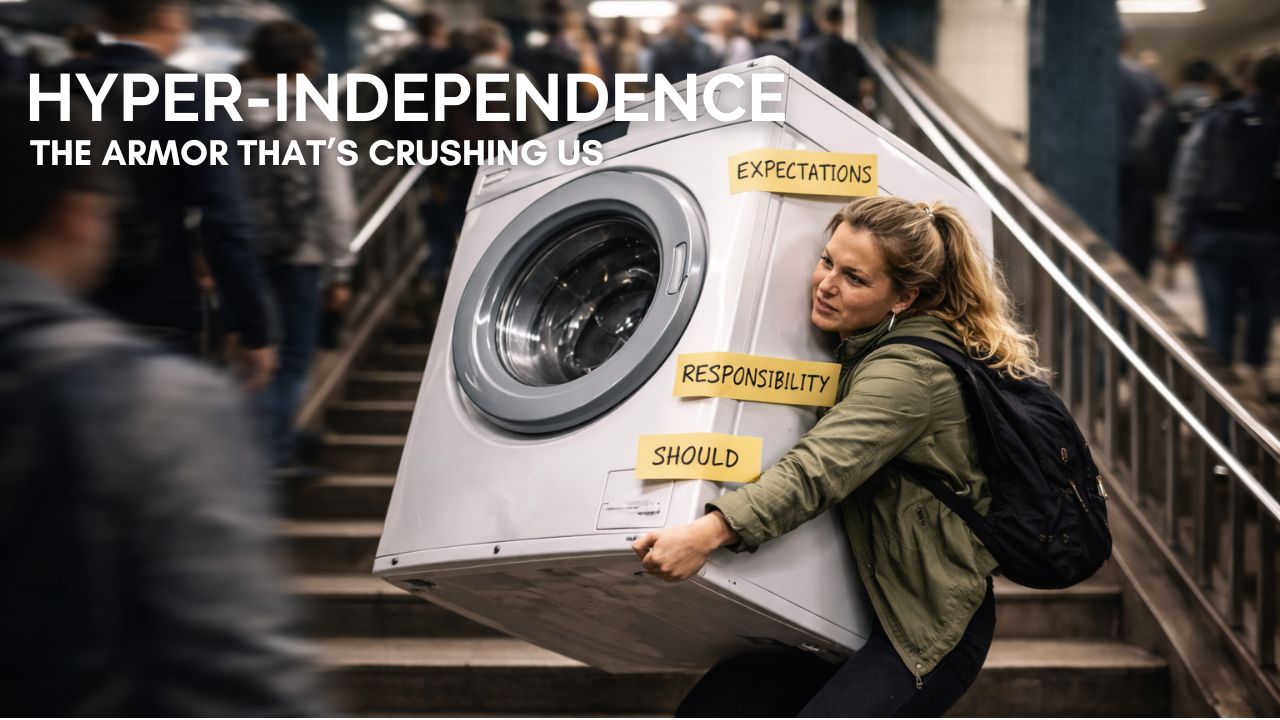
Hyper-Independence: When Strength Becomes Survival
“I’ve got this.”
Even when you don’t.
Even when you’re breaking inside.
If you’ve ever said those words while carrying far more than anyone realizes, you already know what hyper-independence feels like.
This episode was personal for me.
I recorded it for two reasons.
One, because at the start of a new year, many of us quietly put even more pressure on ourselves to do everything alone.
And two, because you might love or live with someone who is deeply hyper-independent, and you don’t know how to help them without pushing them away.
So let’s talk about it honestly.
What Hyper-Independence Looks Like in Real Life
I’m looking out my window right now.
It’s January.
Everything is white.
Snow everywhere.
A year ago, even a month ago, I couldn’t get my driveway cleared.
I have two crushed discs in my back. I’m strong. I’m capable. I’ve removed an absurd amount of snow in my life. But I couldn’t do it anymore.
I was a single mom. Still am. Running a business. Carrying too much. And I remember what it felt like to walk down my street to a neighbor I barely knew and ask for help.
It felt like a walk of shame.
It felt humiliating.
I was almost in tears just walking there.
And then the guilt.
The guilt when they helped.
The guilt when they helped again without asking.
The guilt when it snowed again and I had to ask again.
Looking back now, I can see it clearly.
My hyper-independence didn’t make me stronger in that moment.
It made everything heavier.
Why Hyper-Independence Forms
Hyper-independence is often praised.
You get things done.
You’re capable.
You don’t rely on anyone.
And all of that is true.
But hyper-independence isn’t just a strength.
Often, it’s a trauma response that’s been misunderstood.
Here’s where it usually comes from.
1. Early Betrayal or Emotional Neglect
When a child learns that no one is coming, they adapt.
If they want breakfast, they make it.
If they want to get somewhere, they figure it out.
If they want support, they stop expecting it.
This isn’t about blame.
It’s about survival.
And that survival response can become hyper-vigilance.
“I have to do it myself.”
2. Cultural or Family Conditioning
In some families or cultures, vulnerability equals weakness.
You’re praised for being strong.
You’re shamed for being a burden.
You’re taught to handle it.
Independence becomes reinforced over and over until it hardens into identity.
3. Control During Chaos
When life becomes overwhelming, control feels like safety.
Divorce.
Single parenting.
Business pressure.
Chronic stress.
Hyper-independence becomes a coping mechanism.
Not who you are.
What you needed to survive.
And when it’s used repeatedly, it becomes habit.
Hyper-Independence Is Not a Badge of Honor
This part matters.
Hyper-independence is not proof of strength.
It’s a scar dressed up as armor.
Heavy armor.
And over time, that armor starts crushing the person wearing it.
The Hidden Costs of Hyper-Independence
1. Exhaustion
Hyper-independent people carry invisible labor.
Emotional labor.
Financial labor.
Logistical labor.
Operational labor.
Especially leaders.
Especially parents.
Especially the people everyone assumes are “fine.”
It’s exhausting to believe you have to carry everything.
2. Loneliness
I remember cooking dinner while four kids did homework at the table and a toddler ran around.
I told myself I couldn’t ask for help.
There wasn’t time.
It was easier to just get it done.
But it was lonely.
When you never let people help, relationships stay surface-level.
Depth comes from working through things together.
Irritation. Frustration. Slowness. Learning.
Hyper-independence avoids all of that.
And in doing so, it avoids intimacy.
3. Being Misunderstood
Capable people get labeled.
“You’re so strong.”
“You’ve got it handled.”
“You always figure it out.”
And then people stop checking in.
One of my clients once said something I never forgot:
“Capable people are punished.”
The most put-together person in the room is often the one struggling the most.
How to Support Someone Who Is Hyper-Independent
This matters if you love someone like this.
Or work with them.
Or lead them.
What Helps
1. Offer specific help proactively
Not “let me know if you need anything.”
That never works.
Instead:
“I’ll drop dinner off Thursday. No pressure to talk.”
Specific.
Proactive.
No burden to initiate.
2. Model interdependence
Let them help you sometimes.
Ask for small things.
It balances the power dynamic and builds trust.
3. Be consistent over time
This one is everything.
Texts.
Calls.
Check-ins.
Without expectation.
Reliability earns the right to closeness.
What Hurts
1. Saying “let me know if you need anything”
They won’t.
They literally can’t.
2. Trying to break through their walls
Pointing out their “issues with asking for help” creates shutdown.
This was a survival strategy.
Not a flaw.
3. Taking their distance personally
It’s not about you.
It’s about history.
Consistency matters more than confrontation.
The Truth About Hyper-Independence
If this resonates with you, hear this clearly.
You are not broken.
You are adaptive.
Even the strongest trees need light and water.
You can be capable.
You can be autonomous.
You can still need others.
And asking for support doesn’t make you weak.
It makes you human.
In fact, it takes more courage to trust than to carry everything alone.
Want to Go Deeper?
Listen to the full episode of the Empowered Team Podcast, where I unpack hyper-independence as a survival response, share personal stories, and explain how to support yourself or someone you love without creating more pressure.
Listen now → https://podcasts.apple.com/us/podcast/hyper-independence-the-armor-thats-crushing-us/id1439022418?i=1000745693593
Ready for support without doing it all alone?
Our coaching programs help leaders and high-capacity humans release survival patterns, build healthier support systems, and lead without burning themselves out.
Learn more here →
https://link.theempowered.ca/widget/bookings/empowered-leadership-consulting-meet-kari


