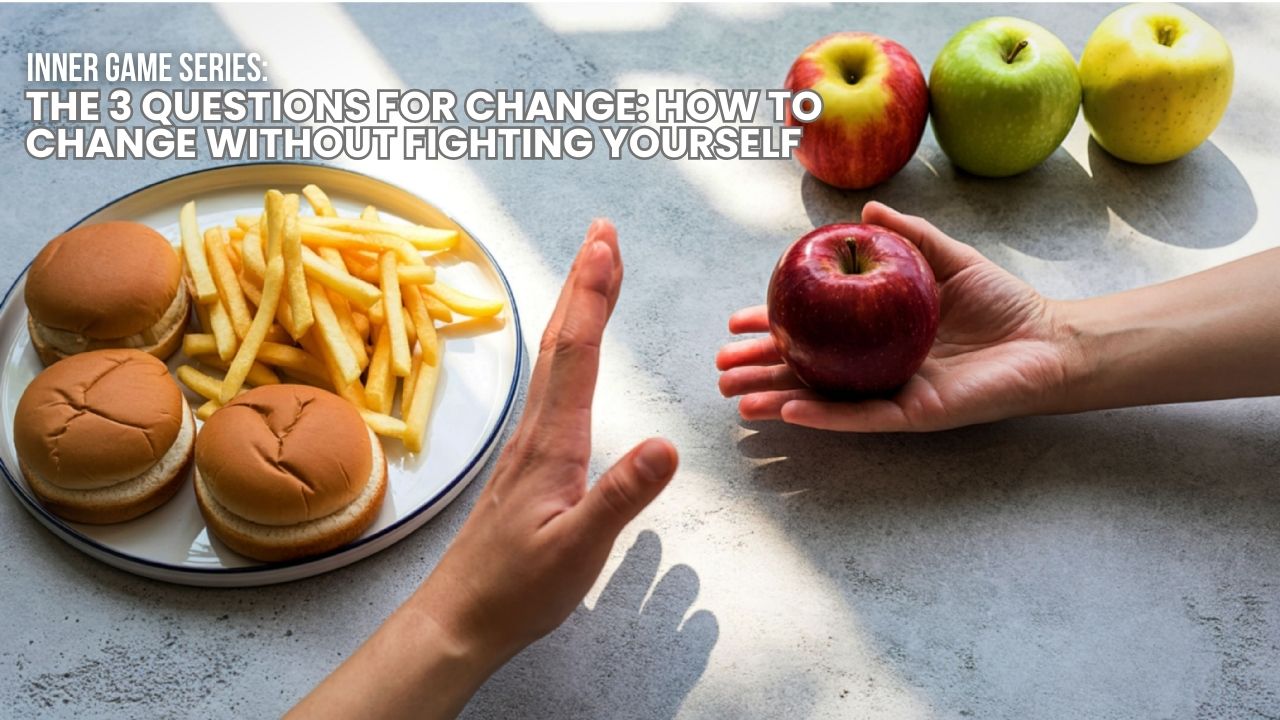
Inner Game Series - The 3 Questions for Change: How to Change Without Fighting Yourself
The Three Questions That Turn Awareness Into Real Change
There is a moment that almost everyone recognizes.
You notice the pattern again.
Maybe it happens in the middle of a conversation. Someone says something that lands wrong and before you even realize it, the reaction is already out of your mouth.
Or maybe it appears in a quieter way. You promised yourself you would handle something differently this time. Be more patient. Be more disciplined. Approach the situation in a way that aligns with the person you are trying to become.
Yet somehow the same behavior shows up again.
The same tone.
The same response.
The same habit.
And the realization comes quickly.
You already knew better.
You had already reflected on it.
You had already seen the pattern clearly.
You had even decided you were ready to change.
But awareness alone didn’t stop the behavior.
That moment can create a surprising amount of frustration.
If I can see the problem so clearly…
why am I still repeating it?
Many people quietly carry this tension.
They understand the pattern, yet the behavior continues.
And eventually they reach a conclusion that sounds logical but creates even more struggle.
Maybe I just need more discipline.
So they push harder.
They try to suppress the impulse.
Force themselves into new habits.
Override what their brain wants to do.
But the harder people fight themselves, the harder change becomes.
The Story Beneath the Surface
High performers and leaders often live with an internal expectation that understanding something should automatically lead to fixing it.
In many areas of life, that belief works.
If you understand a business problem, you can solve it.
If you understand a strategy gap, you can correct it.
If you understand a system failure, you can redesign it.
But human behavior works differently.
A person can fully understand their patterns and still repeat them.
They can see exactly what they want to change and still struggle to follow through.
Not because they lack intelligence.
Not because they lack commitment.
But because behavior lives deeper than awareness.
The brain is built to protect familiarity.
Patterns that once helped us cope with stress, pressure, or uncertainty become embedded in the nervous system. Over time those responses begin to feel automatic.
They stop feeling like choices.
They start feeling like instincts.
How This Pattern Gets Reinforced
Every pattern begins as a response to something.
Pressure.
Stress.
Emotion.
Uncertainty.
At some point in the past, a particular behavior created relief.
Maybe it was snapping at someone when frustration built up.
Maybe it was reaching for comfort food after a long day.
Maybe it was taking control of every detail in a business because that once helped things succeed.
In that moment, the brain learned something important.
That worked.
It may not have been perfect.
It may not have been healthy.
But it resolved the moment.
So the brain saved it.
And the next time a similar situation appeared, the brain offered the same response again.
Repeat.
Over time, this loop strengthens.
Thoughts become beliefs.
Beliefs become behaviors.
Behaviors create outcomes.
The cycle repeats until the pattern becomes automatic.
This is why removing a behavior alone rarely works.
The brain does not like empty space.
When a familiar pattern disappears, the brain immediately looks for something to replace it.
Without a new direction, it simply pulls the person back to what it already knows.
A Real Moment That Changed Perspective
Imagine someone who has spent years building a business.
The environment requires constant action. Decisions happen quickly. Problems demand immediate response.
The pace becomes normal.
Speed, control, and relentless responsibility shape the way that person operates every day.
Then something changes.
The business is sold.
The role shifts.
Life moves into a new chapter.
But something surprising happens.
The patterns remain.
The urgency is still there.
The reactions are still automatic.
The brain keeps responding as if the old environment still exists.
Even when the external circumstances have changed, the internal patterns continue to run.
That realization can be powerful.
Because it reveals something most people overlook.
Change does not happen simply because circumstances change.
Patterns stay active until something intentionally replaces them.
This is where many people misunderstand the work of personal growth.
They believe change means stopping something.
In reality, change means choosing something better.
Why This Is Hard to Change Alone
Modern environments rarely slow down enough for people to reflect on their internal patterns.
Leaders are expected to move quickly.
Professionals are rewarded for productivity.
Teams depend on decisive action.
Speed becomes the norm.
But speed often bypasses awareness.
When life moves quickly, behavior runs on autopilot.
Even when someone recognizes a pattern they want to change, the environment around them may still reinforce the old behavior.
Colleagues expect the same reactions.
Systems reward the same habits.
Relationships are built around familiar roles.
Without support or intentional reflection, the brain defaults to what it knows best.
This is why awareness alone rarely produces lasting transformation.
People see the pattern clearly, but they have not yet changed the internal process that guides their choices.
What This Really Requires
Sustainable change begins with honesty.
Instead of denying impulses or pretending they are not there, people begin acknowledging them.
Not with judgment.
With curiosity.
Recognizing the impulse creates space between reaction and response.
Within that space, something powerful becomes possible.
Choice.
Instead of repeating the automatic pattern, a person begins selecting a better option.
Not perfect.
Just better.
Over time, these small shifts become new patterns.
But one final element makes those patterns sustainable.
Meaning.
When behavior connects to identity and values, the effort changes completely.
Instead of forcing yourself to act differently, the action begins to reflect who you are becoming.
The thought shifts from obligation to intention.
This matters to me.
And when behavior aligns with identity, persistence becomes much easier to maintain.
Where This Leaves You
Change does not have to feel like a constant battle with yourself.
It does not require suppressing every impulse or forcing discipline through exhaustion.
Most lasting transformation begins with something quieter.
Noticing the moment.
Acknowledging the pattern.
Choosing something slightly better than the automatic response.
And remembering why that choice matters.
Over time, those small shifts create new direction.
The internal tension softens.
And the person you are becoming begins to feel more natural than the patterns you once repeated.
Want to Go Deeper?
Check out the episode of the Empowered Team Podcast, Kari Schneider explores how sustainable change happens when we stop fighting ourselves and begin guiding the inner game.
She introduces three powerful questions that help turn awareness into intentional action and make change far more likely to stick.
Listen to the full episode here:
{{Podcast Link}}
If you are navigating meaningful change in leadership, identity, or life direction, you can also connect with Kari for a deeper conversation about alignment and self-mastery.
Book a conversation here:
https://link.theempowered.ca/widget/bookings/empowered-leadership-consulting-meet-kari
Real transformation begins with the inner game.
And when the inner game shifts, everything else begins to move with it.


